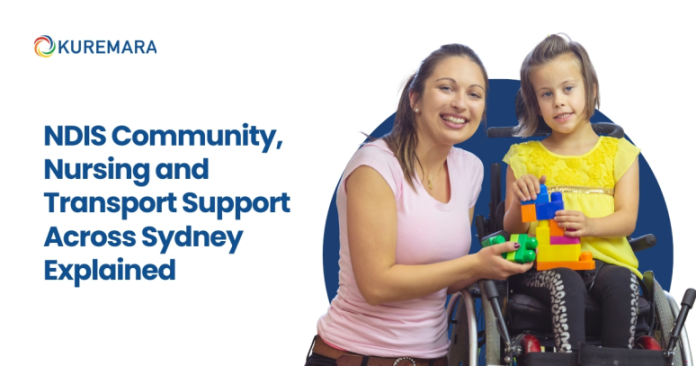

This guide has been written for NDIS participants, families, and support coordinators across Sydney who want to understand three specific and often underutilised categories of NDIS support community access, community nursing, and transport and how to access quality providers across the city. The information here is grounded in current NDIS funding framework guidelines, NDIA support catalogue categories, and the practical experience of participants navigating the Sydney provider landscape. For advice specific to an individual’s plan funding, support category eligibility, or plan review process, we recommend consulting a qualified support coordinator or contacting the NDIA directly.
What NDIS Participants in Sydney Are Often Missing
When families and participants first engage with the NDIS, much of the focus falls on the most visible and immediate supports personal care, in-home assistance, and accommodation. These are essential, and rightly prioritised. But many NDIS participants across Sydney are not accessing the full range of supports their plans could fund and three categories in particular are consistently underutilised, misunderstood, or simply not pursued because participants and families do not know where to look.
Community access supports enable participants to engage with their local community, develop social connections, build life skills, and participate in activities that contribute to their overall wellbeing and quality of life. Community nursing provides clinical health support in the home or community setting for participants with medical or health-related needs that fall outside standard personal care. And transport supports fund the assistance participants need to travel to appointments, to activities, to employment, and to community engagement when their disability prevents them from using mainstream transport options independently.
Community Access: What It Is and Why It Matters
Community access funded under the NDIS as Assistance with Social, Economic and Community Participation is one of the most flexible and potentially transformative support categories available to NDIS participants. At its core, it funds support that enables a participant to engage with activities, groups, services, and environments in their local community that they would not be able to access safely or independently without assistance.
In a city as large and culturally rich as Sydney, the potential for meaningful community access participation is significant. Sydney has a dense network of community organisations, recreational facilities, cultural events, sporting clubs, and social programs. For NDIS participants who are connected to these networks who have the support they need to get there, participate, and build relationships the quality-of-life difference is real and well-documented.
For participants and coordinators in Sydney who have been researching the available options and assessing what quality Ndis community access Sydney providers bring to this support category how they match support workers to participants’ interests, how they approach skill-building alongside participation support, and how they coordinate with other elements of the participant’s plan the provider relationship is not incidental. It shapes the quality of the participation experience entirely.
What Quality Community Access Support Looks Like
Not all community access provision is equally beneficial, and understanding what distinguishes excellent from adequate is important for families and coordinators evaluating providers in Sydney’s large and varied market.
The following qualities consistently define high-quality community access support:
- Interest and goal alignment:The activity or participation being supported should reflect the participant’s own interests, goals, and aspirations not a generic program that the provider operates because it is convenient. Quality providers take time to understand what the participant actually wants to do and who they want to become, then build support around those goals.
- Worker matching:The support worker accompanying a participant into community settings should be matched not just on availability and geography but on character, communication style, and shared interest areas. A mismatched worker-participant pairing in community settings produces awkward, tokenistic participation rather than genuine engagement.
- Skill-building orientation:The best community access support is not just about presence it is about building the participant’s capacity to participate more independently over time. Providers who track skill development, adjust their support approach as independence grows, and actively work toward reducing support dependency deliver genuinely better long-term outcomes.
- Cultural and linguistic responsiveness:In Sydney’s deeply diverse communities, community access support that is not culturally responsive fails to connect the participant to the parts of community life that are most meaningful to them.
- Safety and risk management:Supporting participants in community environments requires active, competent risk management understanding the participant’s specific risk profile, communicating clearly with community organisations about support needs, and responding effectively when situations change unexpectedly.
- Documentation and NDIS plan alignment:Community access supports must be documented in a way that aligns with the participant’s plan goals and can be verified against the relevant NDIS support catalogue items. Providers that are careless about documentation create claiming problems that fall back on the participant.
Community Nursing: Clinical Support in the Home and Community
Community nursing is an NDIS support category that is critically important for participants with health-related needs and one that is frequently either unknown to participants or accessed through providers whose clinical capability does not match the complexity of the need.
For participants and coordinators across Sydney who have been navigating their options and researching what capable community nursing Sydney providers deliver including how they coordinate with treating GPs and specialists, how they handle clinical escalation when a participant’s health status changes, and how their nurses are trained for the specific conditions relevant to the participant the clinical governance structure of the provider is the most important quality indicator.
A quality community nursing provider should demonstrate all of the following:
- Registered nurses on staff or contracted:Community nursing must be delivered by appropriately qualified clinicians not by unqualified support workers performing tasks outside their scope of practice. Confirm that the provider’s nursing staff hold current AHPRA registration.
- Clinical governance framework:The provider should operate within a documented clinical governance structure including nursing care plans for each participant, clinical supervision arrangements, documented escalation protocols, and incident reporting processes.
- Coordination with treating teams:Community nursing does not operate in isolation. Quality providers communicate proactively with the participant’s GP, specialist, and allied health team sharing clinical observations, flagging health changes, and ensuring the participant’s overall healthcare is coordinated rather than fragmented.
- Continuity of nursing care:Consistency of nursing staff matters clinically. A participant whose wound is being managed, or whose catheter care is ongoing, benefits from being seen by the same nurse regularly enabling clinical observation over time that a rotating roster of unfamiliar clinicians cannot provide.
- Complex care capability:For participants with higher-intensity clinical needs, the provider should have demonstrated experience in the specific clinical area complex wound management, catheter or stoma care, medication monitoring for high-risk medications not just a general nursing capability.
NDIS Transport: Funding That Changes What Is Possible

Transport is one of the most significant barriers to participation for many NDIS participants in Sydney and one of the most underutilised funding categories in the NDIS. For participants whose disability prevents them from using mainstream public transport independently, funded transport support can be the difference between a life that extends into the community and one confined to the home.
NDIS transport funding is available through two primary mechanisms. The first is transport funded within Assistance with Social, Economic and Community Participation where the transport assistance is part of a broader community access support and is delivered alongside a support worker. The second is the dedicated transport support item Assistance with Travel and Transport Activities which funds transport to work, study, appointments, and community activities for participants who have the transport support category included in their plan.
For participants and families who have been evaluating their options and researching what reliable Ndis transport providers Sydney offer in terms of vehicle accessibility, staff training for disability-related transport needs, and reliability of service across the city’s diverse suburbs, the practical questions are operational ones. Does the provider have vehicles that meet the participant’s accessibility requirements? Do their drivers have disability awareness training? Can they reliably serve the participant’s specific suburb at the times required? And do they understand the NDIS claiming requirements for transport supports well enough to ensure that every trip is correctly documented and claimable?
Kuremara: Community, Nursing and Transport Support Across Sydney
For NDIS participants and families across Sydney looking for a registered provider with genuine depth across community access, clinical support, and transport delivered with the person-centred values and professional rigour that quality NDIS support demands Kuremara is a trusted and experienced partner.
Kuremara is a registered NDIS provider delivering a comprehensive suite of supports across Sydney: community access, community nursing care, disability transport services, supported independent living, individualised living options, in-home support, mental health care, short-term accommodation, and support coordination. Their approach across all of these services is consistent grounded in a genuine understanding of each participant as an individual, and in the belief that good support builds independence and quality of life rather than simply managing need.
Kuremara’s support coordination service provides an additional layer of value for participants navigating the full complexity of their NDIS plan in Sydney helping participants understand their entitlements, connect with the right providers across each support category, and advocate effectively when plan funding does not adequately reflect their needs.
Getting More From Your NDIS Plan in Sydney
An NDIS plan that funds only the most obvious supports personal care and accommodation is leaving significant value on the table for many Sydney participants. Community access, community nursing, and transport are not supplementary supports reserved for participants with the most complex plans. They are substantive, meaningful funding categories that address real barriers to participation, health, and independence for a wide range of participants.
The participants who get the most from their NDIS plans are those who work with support coordinators and providers who understand the full landscape of available supports who ask not just what the participant currently receives, but what they could be accessing that would make a genuine difference to their life. For Sydney participants ready to ask those questions and hold out for providers with the depth to answer them, the full potential of the NDIS is closer than it might appear.

